
The knee made simple
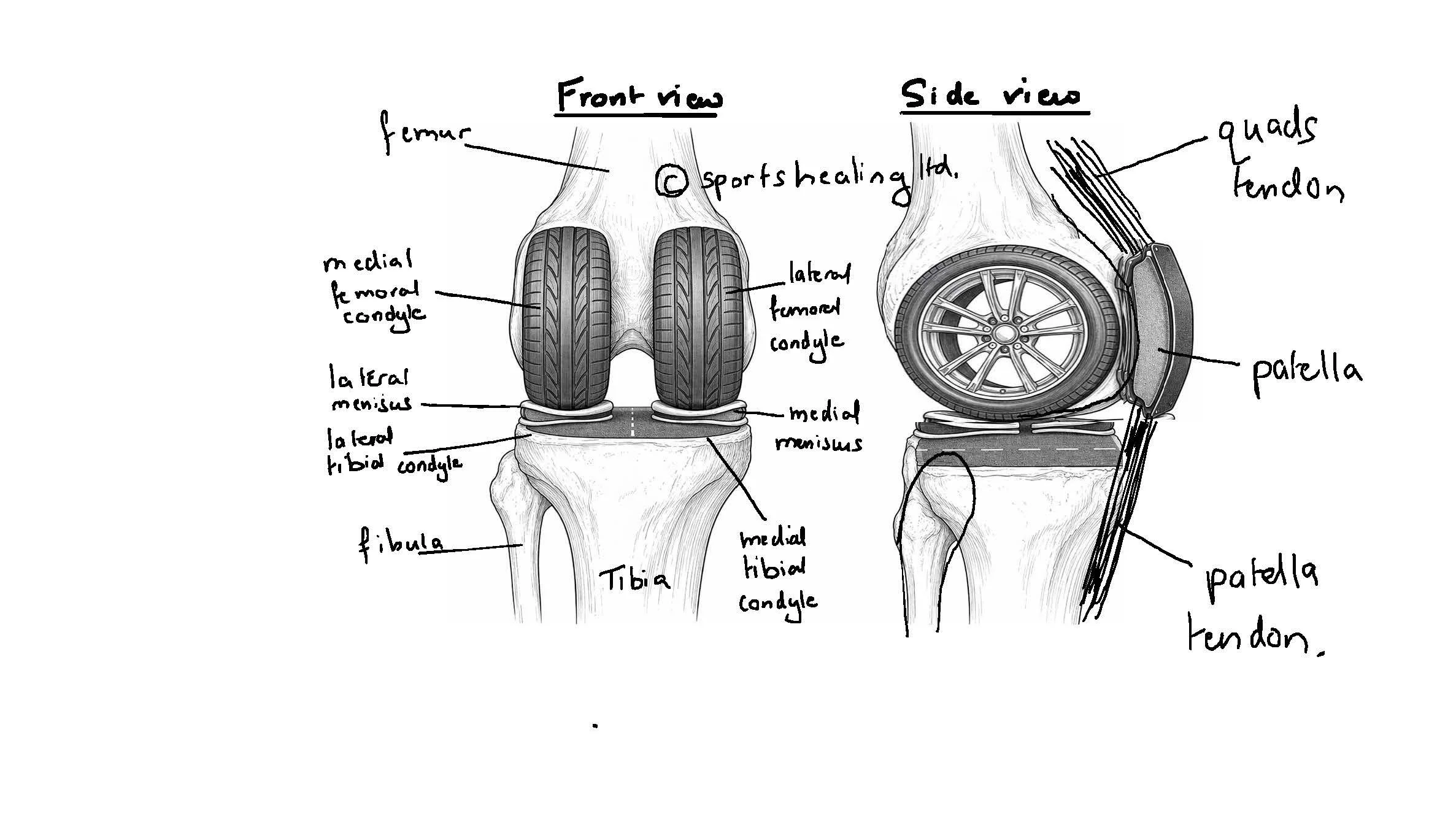
Why the Knee Is Like a Car: Understanding Joint Function Through Mechanics
The knee can be understood most clearly when viewed as a precision mechanical system, similar to a car. This analogy is not superficial. It reflects the fundamental biomechanics of how the joint bears load, moves efficiently, and maintains stability under stress.
At its core, the knee behaves like a wheel interacting with a road surface. The femur, the upper bone of the knee, functions like a tyre. It rolls and transmits body weight through the joint. Beneath it, the tibia acts as the road, receiving and distributing that load. Just as a tyre must maintain optimal contact with the road for smooth driving, the knee depends on a well-matched interface between these two surfaces.
Between them sit the menisci, which can be compared to adaptive suspension pads. These structures are not passive cushions. They deform dynamically under load, increasing the contact area between the femur and tibia. In mechanical terms, this reduces pressure and prevents excessive wear. When the meniscus is damaged or removed, the system behaves like a tyre on a narrow or uneven surface. Load becomes concentrated, accelerating joint degeneration and leading to arthritis.
The patella, or kneecap, introduces another critical mechanical feature. It functions like a brake pad positioned over a rotating wheel. Its role is to improve the efficiency of the quadriceps muscle, allowing controlled deceleration and powerful extension of the knee. Without the patella, the system loses leverage, much like a braking system that lacks proper contact with the wheel. However, if forces across the patella become excessive or misaligned, this can lead to pain, similar to uneven brake wear in a vehicle.
Stability within the knee is maintained by the ligaments, which can be compared to the alignment and suspension system of a car. The ACL and PCL act as central stabilising cables, controlling forward and backward motion as well as rotation. The collateral ligaments function like side supports, preventing excessive deviation. When these structures fail, the system loses control. The tyre may still contact the road, but its movement becomes unpredictable and inefficient.
Importantly, the knee is not a simple hinge. It combines rolling, sliding, and rotation, much like a tyre adjusting to changing terrain. This complexity allows for agility but also makes the joint vulnerable when any component is compromised.
Understanding the knee as a car highlights a key principle. Every part of the system is interdependent. Damage to one structure alters load distribution, increases mechanical stress, and accelerates failure elsewhere.
This is why preserving structure, restoring alignment, and maintaining smooth mechanics are central to modern knee treatment.
Best Knee Information Page | Expert Knee Surgeon London | ACL & Knee Replacement Specialist
Understanding your knee is the first step to treating pain, injury, or instability. At ChinmayGupte.com, we use clear, clinically accurate explanations to help you make informed decisions about your care with a leading knee surgeon in London.
Common Knee Problems
Patients often present with:
ACL injuries causing instability or “giving way”
Meniscal tears leading to pain, locking, or swelling
Cartilage wear (osteoarthritis) causing stiffness and reduced function
Patellofemoral pain from overload or maltracking
As a specialist ACL surgeon in London, Professor Chinmay Gupte offers advanced assessment and treatment tailored to each condition.
Why Biomechanics Matters
Damage to one part of the knee affects the whole system:
Loss of meniscus reduces load distribution, increasing pressure
Ligament injury (such as ACL rupture) causes instability and abnormal motion
Malalignment leads to uneven wear and early arthritis
This is why expert evaluation by a top knee surgeon in London is important. Accurate diagnosis guides the correct treatment pathway.
Treatment Options
Management depends on the condition and patient goals:
Non-surgical care: physiotherapy, targeted rehabilitation, injections
ACL reconstruction**: restoring stability for sport and activity
Meniscal repair or preservation**: protecting long-term joint health
Knee replacement surgery**: for advanced arthritis
Professor Gupte is recognised as a leading knee replacement surgeon in London, using modern techniques including robotic-assisted surgery to optimise outcomes.
Why Choose Assoc Professor Chinmay at ChinmayGupte.com
Internationally recognised expertise in knee surgery
Specialist in ACL reconstruction and complex knee injuries
Children’s an adult knee specialist
Evidence-based, patient-centred approach
Access to advanced imaging and personalised rehabilitation pathways
Next Steps
If you are experiencing knee pain, instability, or reduced performance, early specialist assessment is essential.
Book a consultation today with a leading knee surgeon in London and take the first step towards restoring your knee health.